
About Us
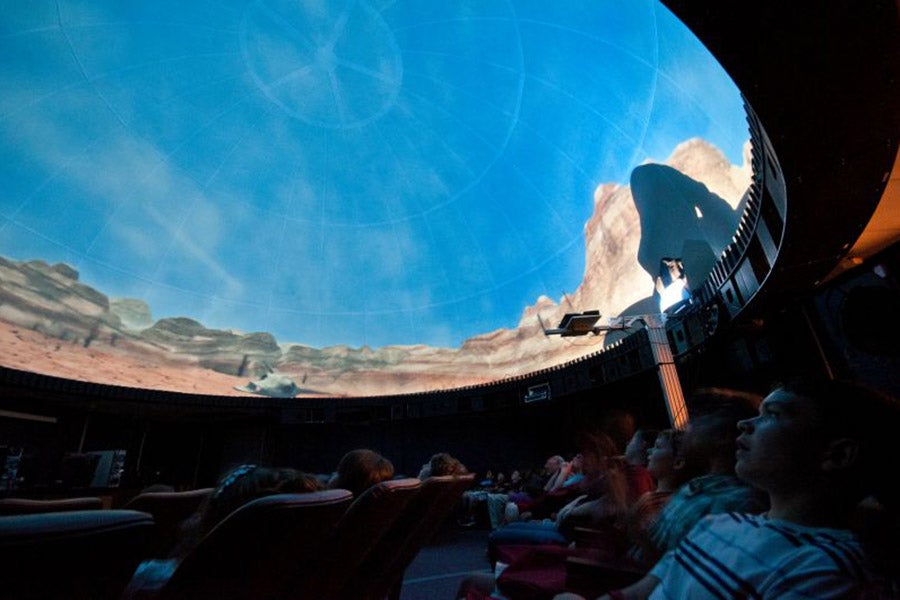
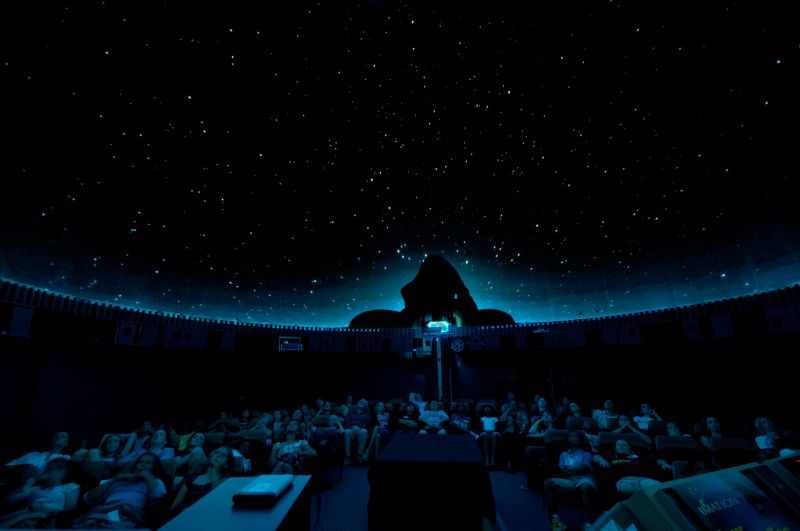
The FSU Department of Physics' Pat Thomas Planetarium has been in operation since 1982 and serves the university and Tallahassee community, including local and regional K-12 schools, home-schooled students, FSU students, clubs, service organizations and the general public. Our half-dome planetarium features a state-of-the-art digital system with high definition projectors, powerful computers and advanced software to project 360 degree images of great beauty and realism.
Teaching astronomy is a big challenge. You want to bring the stars and planets to your students in an engaging and enjoyable way. But the topic is complicated and needs lots of equipment and time to teach — and you can't always get your students together to look at the night sky.
This is where we can help. We have the resources and expertise to help you teach astronomy effectively.
Software and Shows
Do you want your students to be able to recognize the stars, planets and constellations? To understand why stars shine, what black holes are and how they work, what makes a telescope so special, where the elements came from? We have shows and software that will capture your students' imagination and help them learn all these topics and more.
We have programs which create an accurate night sky from anywhere in the solar system and at almost any time. We can put you in Egypt, 2500 B.C., where your students can see the North Star wasn’t Polaris at all—it was Thuban! Do you want them to see a solar eclipse? We can put you in the path of totality, and you can experience darkness at noon.
We also have excellent pre-rendered shows devoted to astronomy and other topics. Our full-dome shows are chosen with young students in mind and are suitable for a wide age-range. View the Show Catalog dropdown to see our updated catalog, where you're sure to find something suitable.
Additional Resources
Perhaps you want your students to learn more about the topics they’ve seen. We can help with that, too. We have a large inventory of teaching demonstrations and activities that can help your students explore and extend what they’ve learned — whether it’s the physics of rocket power, or whether Mars ever had running water, the fabric of space-time, and many others.
For example, four middle school students recently completed a tutorial program where, during their weekly visits, they not only learned how to write scripts for Stellarium® — our digital planetarium software — they also learned about the night skies, planets, stars, galaxies, cosmology and physics. Their scripts are so good we are in the process of setting them up for widespread use!
The Pat Thomas planetarium can help you plan an appealing, exciting and educational visit for you and your students. Just contact us with your needs.
We welcome members of the general public, including families, community service organizations, Scout troops, clubs, students, etc. If you'd like to reserve the planetarium, please contact Mark Cartagine.
We are a free service to the community and can seat up to 78 guests at a time, with a requested minimum group of eight. Our hours of operation are 9:30 a.m. to 6:30 p.m. Monday through Friday (subject to availability). Other times may be available on special request but are not guaranteed. Please contact us at least three business days in advance.
To plan your visit, please contact Mark Cartagine with the following information:
- Name of contact
- Cell number
- School, if applicable
- Number of visitors
- Requested date and time
- Requested show (see below)
- Any other accommodations or requests
BIG
BIG. One of the most asked questions about the universe is “How big is it?”—and that’s one of the hardest to answer. BIG has been produced to tackle the question and takes the audience on an immersive journey to the far reaches of the observable universe. Along the way, they meets a huge range of objects to spark their imagination.
Unlike any show you have seen before, BIG combines a light-hearted storytelling style with computer animation, stop-motion character animation, laser graphics, and a musical score to bring a really big subject down to Earth.
Narrated by Sir Richard Attenborough.
Length: Approx. 20 min.
Age Range: 7+
Black Holes
Black Holes takes you on a journey through one of the most mystifying, awe-inspiring, phenomena in the universe: a black hole. Where do they come from? Where do they go? How do we find them? Is there one on Earth's horizon?
We invite you to join us in exploring the science and mystery of Black Holes.
Length: Approx. 40 min.
Age Range: 10+
Cosmic Castaways
There are places where the night sky has no constellations. No Orion, no Big Dipper, nothing but a few lonely, far away stars and a few faint, ghostly patches of light. Most stars lie within the crowded boundaries of galaxies, traveling with their brothers and sisters in a vast galactic family. But some find themselves on their own, deep within voids between the galaxies. These are the cosmic castaways.
Come explore what happens when galaxies travel past and into each other. See how they change the universe around them. Find out how a galactic collision can leave cosmic castaways in its wake.
Length: Approx. 20 min.
Age Range: 11+
Earth, Moon and Sun
Coyote has a razor-sharp wit, but he’s a little confused about what he sees in the sky.
Join this amusing character — adapted from American Indian oral traditions — in a fast-paced and fun full-dome show that explores lunar phases, eclipses, how the Sun creates light and heat, and other puzzles.
Engaging and immersive, Earth, Moon and Sun also examines how humans learn through space exploration. Younger viewers really love this show.
Length: Approx. 26 min.
Age Range: 5+
From Earth to the Universe
The night sky, both beautiful and mysterious, has inspired awe and been the subject of campfire stories, and ancient myths for as long as there have been people. A desire to comprehend the Universe may well be humanity’s oldest shared intellectual experience. Yet only recently have we truly begun to grasp our place in the vast cosmos. To learn about this journey of celestial discovery, from the theories of the ancient Greek astronomers to today’s grandest telescopes, we invite you to experience From Earth to the Universe.
This stunning voyage through space and time conveys, through sparkling sights and sounds, the Universe as revealed to us by science.
Length: Approx. 30 min.
Age Range: 8+
Galileo
Travel back in time to Pisa, Italy, to experience Galileo’s early experiments with gravity and the laws of motion, his advocacy of the idea that the Earth revolves around the sun, still an absurd notion to many in the 1600s, and his work with early telescopes. Learn how his keen observations culminated in The Starry Messenger, an early masterpiece in which Galileo described all his dazzling discoveries in a straightforward, easy to understand way. Narrated by Dava Sobel, author of the award-winning biography Galileo's Daughter.
Length: Approx. 28 min.
Age Range: 13+
(Note: Parents and educators are advised this show mentions Galileo had children out of wedlock.)
Nine Planets and Counting
How many planets are there? Nine? Eight? Ten? Twelve? Audiences want to know, or they wouldn't keep asking the same question every day!
Nine Planets and Counting presents the continuing debate in an open-ended manner. What is the definition of a planet? How many are there? The show includes a tour of the solar system, spectacular photographs, exciting new discoveries beyond Pluto, and a presentation that won't be outdated next week.
Length: Approx. 39 min.
Age Range: 7+
Once Upon the Big Bang
The Big Bang Theory is one of the leading explanations for how the Universe came to be. The universe as we know it, started with a singularity — an infinitesimally small point — inflating over the next 13.8 billion years to the cosmos that we know today. Once upon the Big Bang explores the fascinating events of the birth of time and space.
Length: Approx.16 min.
Age Range: 11+
Phantom of the Universe
Phantom of the Universe is a new planetarium show that will showcase an exciting exploration of dark matter, from the Big Bang to its anticipated discovery at the Large Hadron Collider.
The show will reveal the first hints of its existence through the eyes of Fritz Zwicky, the scientist who coined the term "dark matter." It describes the astral choreography witnessed by Vera Rubin in the Andromeda galaxy and then plummets deep underground to see the most sensitive dark matter detector on Earth, housed in a former gold mine.
From there, it journeys across space and time to the Large Hadron Collider at CERN, speeding alongside particles before they collide in visually stunning explosions of light and sound, while learning how scientists around the world are collaborating to track down the constituents of dark matter.
Length: Approx. 25 min.
Age Range: College, with science background helpful
Secret Lives of Stars
Not all stars are created equal. Some are massive. Others are tiny; almost insignificant. The specific characteristics of a star will determine what type of life it will lead, how long it might live and even the type of death it will die. We will witness the amazing variety of stars and peer into their secret lives.
Narrated by Sir Patrick Stewart of TV's Star Trek: The Next Generation and the X-Men films.
Length: Approx. 25 min.
Age Range: 7+
Skyquest
Come along with a young woman on her personal quest to find a special place in the night sky, from her childhood adventures on Mars, via a cardboard rocket, to the discovery of her "birthday star" that led her to become an astronomer and build a mountain observatory to further her lifelong fascination with the heavens.
She shares her telescope views of the moon, Mars, Jupiter and Saturn with us; points out stars and constellations; and encourages everyone to make the time to look up, even if stargazing in urban areas with light pollution.
Skyquest is particularly appropriate for younger viewers.
Length: Approx. 25 min.
Age Range: 5+
Solar Quest
Solar Quest is a planetarium short feature that demonstrates and provides an overview of the sun-Earth environment.
Detailed and high quality animations and videos demonstrate various solar phenomena such as fusion, light energy and solar surface features and phenomena.
The show also discusses the impacts that space weather may have and how the Earth’s atmosphere and magnetic field protects all life on Earth.
Highlighted in the show is the role of the Solar Dynamics Observatory, or SDO, and how scientists have begun to use it as a way to help identify and predict severe space weather.
Length: Approx.10 min.
Age Range: 9+
Stars – The Powerhouses of the Universe
Every star has a story. Some are as old as time, faint and almost forgotten. Others burn bright and end their lives in powerful explosions. New stars are created every day, born of vast clouds of gas and dust. Through every phase of their existence, stars release the energy that powers the Universe. Journey to the farthest reaches of our galaxy and experience both the awesome beauty and destructive power of STARS.
The stunning animation highlighted by astronauts, spacecraft, telescopes, nebulas, clusters, and more, was created by the talented team of the National Space Centre in Leicester, U.K. This dramatic program features the voice talent of Mark Hamill.
Length: Approx. 26 min.
Age Range: 8+
Sunstruck
Discover the wonders of our sun. Its incredible energy has supported life on earth for millennia, but is now threatening our technology and way of life. Travel to the distant future to discover our sun’s connection to the universe’s cosmic cycle of life and death.
Length: Approx. 21 min.
Age Range: 7+
The Dark Matter Mystery
What are the building blocks of our universe? We've been trying to answer this question since time immemorial — however we still haven't found the ultimate answer. Approximately a quarter of the universe consists of mysterious dark matter. We know: It is there, however, we don't know what it is made up of.
This planetarium show takes you on the biggest quest in astrophysics. You'll see why we know that there must be dark matter at all. Join the scientists on their observations out in space, as well as deep under ground. Will they be able to reveal dark matter's mystery?
Length: Approx. 38 min.
Age Range: 11+
The Hot and Energetic Universe
The Hot and Energetic Universe presents the fascinating world of high energy astrophysics. High energy astrophysics plays a key role in understanding the universe, as these very hot frequencies reveal the processes in the hot and violent universe. High energy astrophysics probes hot gas in clusters of galaxies, which are the most massive objects in the universe. It also probes hot gas accreting around supermassive black holes in the centers of galaxies. Finally, high energy radiation provides important information about our own galaxy, neutron stars, supernova remnants and stars like our sun which emit copious amounts of high-energy radiation. Come and learn about your hot and energetic universe!
Length: Approx. 30 min.
Age Range: 11+
The Making of a Star and Her Entourage
The Making of a Star and Her Entourage traces the evolution of humankind’s understanding of the universe. Discover the long journey beginning with the Earth-centered model of the universe, in which the sun was considered a planet, to our current understanding that the sun is a star centered in the Solar System and is one of billions that reside in the Milky Way.
Length: Approx. 30 min
Age Range: 8+
Trip Through Space
Trip Through Space takes an exciting tour of several constellations found in the winter evening sky, the Solar System, stars, nebulae, galaxies and more. Younger viewers really like this show.
Length: Approx 28 min.
Age Range: 6+
Two Small Pieces of Glass – The Amazing Telescope
While attending a local star party, two students learn how the telescope has helped us understand our place in space and how telescopes continue to expand our understanding of the Universe. Their conversation with a local female astronomer enlightens them on the history of the telescope and the discoveries these wonderful tools have made. The students see how telescopes work and how the largest observatories in the world use these instruments to explore the mysteries of the Universe.
Length: Approx. 25 min.
Age Range: 9+
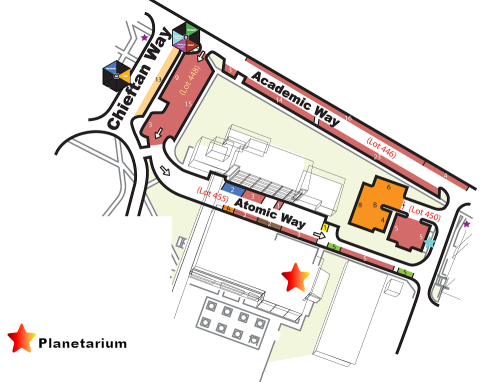
The Planetarium is located in the Richards Building (UPL) across the quad from the Keen Building, in Section B-4:
Parking at FSU can be quite challenging. We suggest consulting the FSU Parking Services website here:
FSU Parking Services
The map shows where to find visitor parking, how much it costs and so on. Per the latest information, buses can still unload visitors directly in front of the planetarium entrance at 1055 Atomic Way. They should turn from Academic Way onto Lot 448 (which is also Atomic Way), and go under the catwalk (it can be done!). Then they can let visitors out, and follow Atomic Way onto Academic Way, and proceed from there to the bus parking lot at the FSU Visitor Center.
Director: Peter Hoeflich (850) 644-5567
Deputy Director: Mark Cartagine (850) 644-1194
How much do you charge for a show at the Pat Thomas Planetarium?
Nothing! We’re free!
How do we book a visit?
Contact Mark Cartagine at (850) 644-1194 or at cartagine@physics.fsu.edu.
What are your hours?
Our normal hours are from 9:30 a.m. to 6:30 p.m. Monday through Friday — subject to availability. Other times may be available on special request, but are not guaranteed. Please contact us at least three business days in advance.
How much advance notice do you need?
Since we book on a “first come, first served” basis, it pays to book as early as possible. Our minimum lead time is three business days.
How many visitors can you accommodate?
Our planetarium has 78 seats.
We have more than 78 in our group; can we still book a show?
Yes – we can split your group into sections. While one section watches a show, the other can participate in a tour of the Nuclear Research Building next door — subject to availability. We need advance notice for this option.
We’re not with a school – can we still book a show?
Yes! The Pat Thomas is open to the public and home-schoolers, as well as schools and other organizations. Just contact us with your needs.
What is the minimum number of visitors?
We ask for groups of eight or more.
Can you make accommodations for special needs?
Yes. Our planetarium is laid out so wheelchairs, for example, can be brought in and the user seated comfortably. Please let us know in advance if a guest needs wheelchair access.
Is there an age minimum?
No, but we recommend you follow the age guidelines listed with the shows in the catalog.